

Last Updated: October 26, 2026
Quick Summary
To get help for elderly parent recovery, start with a professional assessment that turns your situation into a written care plan. Most families combine in-home care, skilled home health, outpatient therapy, or adult day programs, and confirm prescriptions, follow-up appointments, and equipment before discharge day.
- In-home care covers bathing, meals, medication reminders, mobility, and light housekeeping.
- The first two weeks home carry the highest risk of medication errors, falls, and missed follow-ups.
- Ask agencies how they train caregivers, handle emergencies, ensure continuity, and replace caregivers who quit.
- Medicare generally covers short-term skilled nursing and therapy after a hospital stay, not long-term daily care.
- Live Easy Home Care provides ACHC-accredited in-home support across Englewood and Northern New Jersey.
Table of Contents
- Why Elderly Parent Recovery at Home Needs a Real Plan
- Types of Recovery Support Available for an Aging Parent
- In-Home Care After Surgery for Seniors: What It Covers
- Post-Hospital Care for Seniors: The First Two Weeks Home
- Senior Fall Prevention at Home During Recovery
- Questions to Ask a Home Care Agency Before You Sign
- Paying for Elderly Parent Recovery Care: Programs Worth Checking
- Booking a Recovery Care Assessment in Northern New Jersey
- Frequently Asked Questions
Why Elderly Parent Recovery at Home Needs a Real Plan
According to Pew Research Center’s 2026 report on family caregiving in an aging America, 68% of adults caring for an aging parent provide care themselves. That is roughly two in three families handling recovery alone, often without training.
Here is the hard truth: recovery at home fails when it runs on love and guesswork. It works when it runs on a plan.
At Live Easy Home Care, we serve families across Englewood, NJ and Northern New Jersey who reach this exact point. Their parent leaves the hospital, and suddenly everyone is a nurse, scheduler, and pharmacist at once. Most guides skip the part that matters: what to arrange before discharge day.
Below, we break down the types of help available, how to vet an agency, and how to pay for it.
Types of Recovery Support Available for an Aging Parent
Elderly parent recovery support falls into four main categories: in-home care, outpatient therapy, adult day programs, and skilled home health. Each covers different needs, and most families use more than one.
- In-home care: help with bathing, meals, medication reminders, and mobility
- Skilled home health: nursing and physical therapy, usually ordered by a doctor
- Outpatient therapy: scheduled PT or OT visits at a clinic
- Adult day programs: supervised daytime care that gives family caregivers a break
The National Institute on Aging’s guide to services for older adults living at home notes that families can also call the Eldercare Locator to find local support.
Most families combine more than one of these four support types, depending on what the parent needs.
| Support type | What it covers |
|---|---|
| In-home care | Bathing, meals, medication reminders, and mobility |
| Skilled home health | Nursing and physical therapy, usually ordered by a doctor |
| Outpatient therapy | Scheduled PT or OT visits at a clinic |
| Adult day programs | Supervised daytime care that gives family caregivers a break |
In-Home Care After Surgery for Seniors: What It Covers
In-home care after surgery for seniors covers the daily tasks that protect a healing body: safe transfers, wound care reminders, meal prep, and watching for warning signs.
A good caregiver does not just cook and clean. They notice when a parent is dizzy, eating less, or skipping pills.
Coverage typically includes:
- Bathing, dressing, and toileting support
- Transfer help from bed to chair to walker
- Medication reminders and food and fluid tracking
- Light housekeeping and laundry
- Companionship and daily check-ins
If you need this in Bergen County, you can review post-surgery care options and request an assessment.
Post-Hospital Care for Seniors: The First Two Weeks Home
The first two weeks home are the highest-risk window in elderly parent recovery. Medication errors, falls, and missed follow-ups cluster here.
Watch out: the most common mistake is assuming the hospital arranged follow-up care. It often has not. Families must confirm appointments, prescriptions, and equipment themselves.
A simple first-week checklist:
- Pick up prescriptions before discharge day
- Confirm the follow-up appointment date
- Set up the walker, commode, or hospital bed
- Remove loose rugs and clear walkways
- Assign one family member to each daily task
Professional support in those weeks can lower the odds of a readmission. Here is how senior care services help prevent hospital readmissions.
Senior Fall Prevention at Home During Recovery
Senior fall prevention at home starts with removing hazards before the first night back. Falls are the leading cause of repeat hospital trips after surgery, and most happen in the bathroom or on stairs.
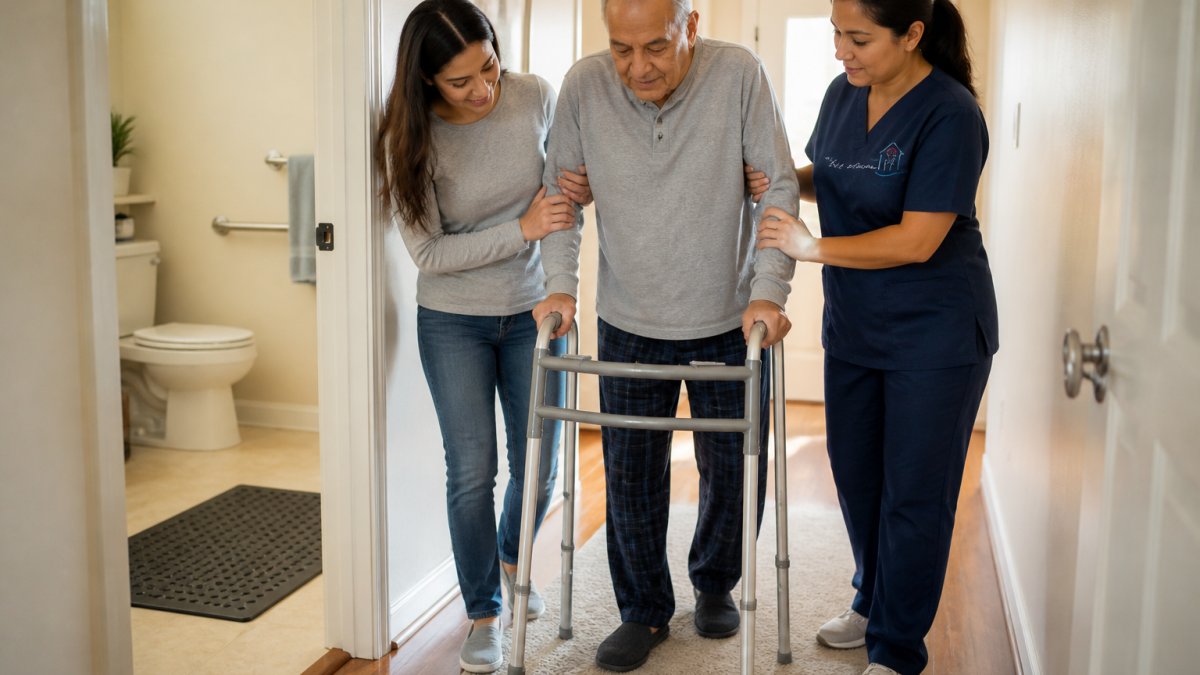
Quick fixes that matter:
- Grab bars in the shower and beside the toilet
- Night lights in hallways and bathrooms
- Shoes with grip, not slippers
- A clear path from bed to bathroom
- A phone or alert button within reach
For a full walkthrough, read our step-by-step fall prevention guide.
Questions to Ask a Home Care Agency Before You Sign
Ask any home care agency four things before signing: how they train caregivers, how they handle emergencies, how they ensure continuity, and what happens if a caregiver quits.
A common mistake is choosing on price alone. The cheaper agency often has higher turnover, and a new face every week is hard on a confused or stubborn parent.
Ask directly:
- Are your caregivers accredited, and by whom?
- What training do they have in dementia and Alzheimer’s care?
- Who answers the phone at 2 a.m.?
- What is your backup plan if a caregiver calls out?
- How do you build trust with a parent who refuses help?
Before you sign anything, use this framework for vetting a home care agency.
Paying for Elderly Parent Recovery Care: Programs Worth Checking
Funding elderly parent recovery care usually comes from a mix of sources: Medicare for skilled services, Medicaid for eligible low-income seniors, long-term care insurance, and VA benefits for veterans.
Medicare generally covers short-term skilled nursing and therapy after a hospital stay, not long-term daily care. Medicaid rules vary by state, so check New Jersey’s official program pages for current eligibility. Veterans should ask the VA directly about aid and attendance benefits.
If your parent has a long-term care policy, this guide to funding at-home senior support explains how to start a claim.
Booking a Recovery Care Assessment in Northern New Jersey
The fastest way to get help for elderly parent recovery is a professional assessment. It turns a stressful guess into a written plan.
Live Easy Home Care provides ACHC-accredited in-home support across Englewood and Northern New Jersey. Our caregivers handle dementia and Alzheimer’s care, 24/7 live-in support, and fall prevention, with personalized care plans for seniors and veterans.
If you are searching for “home care near me” in Bergen or Morris County, start with a conversation. We will walk through your parent’s needs and build a plan that protects their dignity and your peace of mind.
Frequently Asked Questions
How do I help an elderly parent recover at home?
Start with the discharge instructions from the hospital and write down every restriction: weight-bearing limits, medication times, wound care, and follow-up appointments. Then match help to those limits rather than guessing. Pew Research Center reports that 68% of adults caring for an aging parent provide care themselves, so you are far from alone in this. If the plan calls for lifting, bathing, or overnight monitoring you cannot safely do, bring in professional support rather than improvising. Ask the hospital’s discharge planner what they recommend before your parent leaves the building.
What should I ask a home care agency before hiring a caregiver?
Ask four things: who supervises the caregiver and how often, what happens if the assigned caregiver quits or calls out, how the agency handles a 2 a.m. emergency, and whether it is accredited by a body such as ACHC. Get the answers in writing. Also ask how caregivers are trained for your parent’s specific condition, whether dementia, a recent hip replacement, or a brain injury. A good agency answers these without hesitation and puts continuity plans in writing, which is the difference between a real backup system and a promise.
When should I hire a caregiver for an elderly parent?
Hire when the gap between what your parent needs and what family can safely provide starts showing up as missed medications, skipped meals, unsteady transfers to the bathroom, or a fall. Recovery is a common trigger: post-hospital care for seniors often requires lifting and overnight supervision that one adult child cannot sustain alongside a job. The National Institute on Aging points families to the Eldercare Locator for local service options, which is a useful starting point. If you are already losing sleep over it, that is usually the signal.
Can a caregiver help with meals, bathing, and mobility during recovery?
Yes. Non-medical home care covers bathing, dressing, toileting, transfers, meal preparation, hydration reminders, medication reminders, and walking assistance, which are exactly the tasks that make elderly parent recovery at home realistic. Skilled nursing or physical therapy is a separate service ordered by a physician. Ask each agency which tasks its caregivers are trained and permitted to perform, especially for mobility after hip or knee surgery, and confirm that fall prevention is part of the care plan rather than an afterthought.
Recovery does not have to mean round-the-clock worry for your family. Live Easy Home Care offers ACHC-accredited caregivers, specialized dementia support, and 24/7 live-in care tailored to your parent. Get started with Live Easy Home Care and give your family the safety and calm that recovery at home deserves.