
Table of Contents
- What a Professional In-Home Care Assessment Actually Covers
- How to Book an In-Home Care Assessment in Englewood, NJ
- Your Home Care Assessment Checklist: What to Prepare
- Questions to Ask a Home Care Agency During the Visit
- What Happens During a Senior Care Needs Assessment
- From Assessment to a Personalized Home Care Plan
- Conclusion: Taking the First Step Toward In-Home Care
- Frequently Asked Questions
Last Updated: October 14, 2026
What a Professional In-Home Care Assessment Actually Covers
Booking a professional in-[home care](/how-care-plans-are-created-for-seniors-receiving-home-care/) assessment is the first practical step toward keeping an aging parent safe at home, and it is not a sales pitch. An in-home care assessment is a structured evaluation, usually 60 to 90 minutes long, in which a nurse or care coordinator observes your parent’s daily functioning, reviews their health history, and identifies safety risks inside the home. At Live Easy Home Care, our ACHC-accredited team performs these assessments before recommending any level of care.

The visit answers one question: what does your parent need to remain safely and comfortably at home? Everything else, from hours per week to caregiver skill level, flows from that answer.
Clinical and Functional Areas Reviewed
The assessment covers two overlapping categories: clinical status and functional ability. Clinical review looks at diagnoses, medications, wound care, and cognitive condition. Functional review looks at what your parent can actually do on their own.
A thorough evaluation typically examines:
- Mobility and fall risk – gait, balance, use of walkers or canes, and hazards like loose rugs or poor lighting
- Medication management – whether pills are taken correctly, on time, and at the right dose
- Cognition and orientation – memory, confusion, and safety awareness, especially important in dementia care
- Activities of daily living – bathing, dressing, toileting, eating, and transferring from bed to chair
- Nutrition and hydration – meal preparation ability and signs of unintended weight loss
- Home environment – bathroom safety, stair access, and emergency exits
Family members often underestimate cognitive decline because they see their parent in familiar settings. A trained assessor spots what familiarity hides.
Ask the assessor to write down the specific safety concerns they observe, not just the care recommendation. That list becomes your to-do list for home modifications, and it is far more useful than a general summary.
How to Book an In-Home Care Assessment in Englewood, NJ
Booking a professional in-home care assessment in Englewood, NJ takes one phone call or a short online form, followed by a scheduling conversation. Most agencies offer an initial consultation, then send a nurse or care coordinator to the home.
When you call, have three things ready: your parent’s address, a brief description of what prompted the call, and your own availability. The agency will ask whether your parent knows about the assessment. Involving them from the start, even just to say “someone is coming to help us plan,” reduces resistance later.
Here is how the process usually runs:
- Initial call – you describe the situation and your main concerns
- Scheduling – the agency proposes a visit time that works for you and your parent
- Pre-visit questions – the coordinator gathers medical history and current medications
- Home visit – the assessor meets your parent, tours the home, and asks questions
- Care plan review – you receive a written recommendation with hours and services
If you are searching for “in-home care assessment near me,” start with agencies that serve your specific county and can confirm their accreditation. Live Easy Home Care serves Bergen and Morris County families.
Do not sign a care agreement before you have the written care plan in hand. Verbal estimates of hours and duties often differ from what the final plan specifies once the assessor has seen the home.
Your Home Care Assessment Checklist: What to Prepare
A home care assessment checklist keeps the visit focused and ensures nothing important gets missed. Prepare these items before the assessor arrives:
- List of all medications, including dosages and prescribing doctors
- Names and contact information for primary care and specialist physicians
- Recent hospitalizations, surgeries, or emergency room visits
- Insurance information, including Medicare or VA coverage
- A written list of your top three concerns about your parent’s safety
- Notes on what your parent can and cannot do independently
- Questions you want answered before you leave the room
Gather the medication list from the bottles themselves, not from memory. Discrepancies between what a senior is prescribed and what they actually take are one of the most common findings in these visits.
If your parent is a veteran, mention it during scheduling. VA benefits can sometimes offset the cost of in-home care, and the agency should be able to explain how to check eligibility with the U.S. Department of Veterans Affairs. Confirm current program details directly with the VA, since eligibility rules and benefit amounts change.
Questions to Ask a Home Care Agency During the Visit
The questions to ask a home care agency matter as much as the assessment itself, because they reveal how the agency operates after the paperwork is signed. Ask them while the coordinator is in your home, not over email.
On caregiver training and dementia care: Ask how caregivers are trained to handle confusion, aggression, or sundowning. A parent with advanced Alzheimer’s may not recognize family members and may become agitated. You want to hear specific de-escalation training, not a general assurance. (Source: The Administration for Community Living (ACL) offers resources on aging in place)
On continuity of care: Ask what happens when a caregiver calls out sick. A good agency has backup coverage built into its scheduling, so you are not scrambling at 6 a.m.
On emergency response: Ask what the process is if something happens at 2 a.m. Understand who you call, how fast a caregiver can arrive, and when the agency escalates to emergency services.
On medical capability: If your parent is recovering from hip surgery or a brain injury, ask whether caregivers have training in transfer techniques, fall prevention, and health monitoring. “Help with cooking and cleaning” is not the same as clinical support.
On cost and fees: Ask for a full written breakdown. Pricing depends on the level of care, hours, and services needed, so ask the agency for a written quote rather than an estimate over the phone.
The best signal of a quality agency is how it answers the uncomfortable questions. If a coordinator hesitates on backup coverage or emergency protocols, that hesitation tells you more than a polished brochure.
What Happens During a Senior Care Needs Assessment
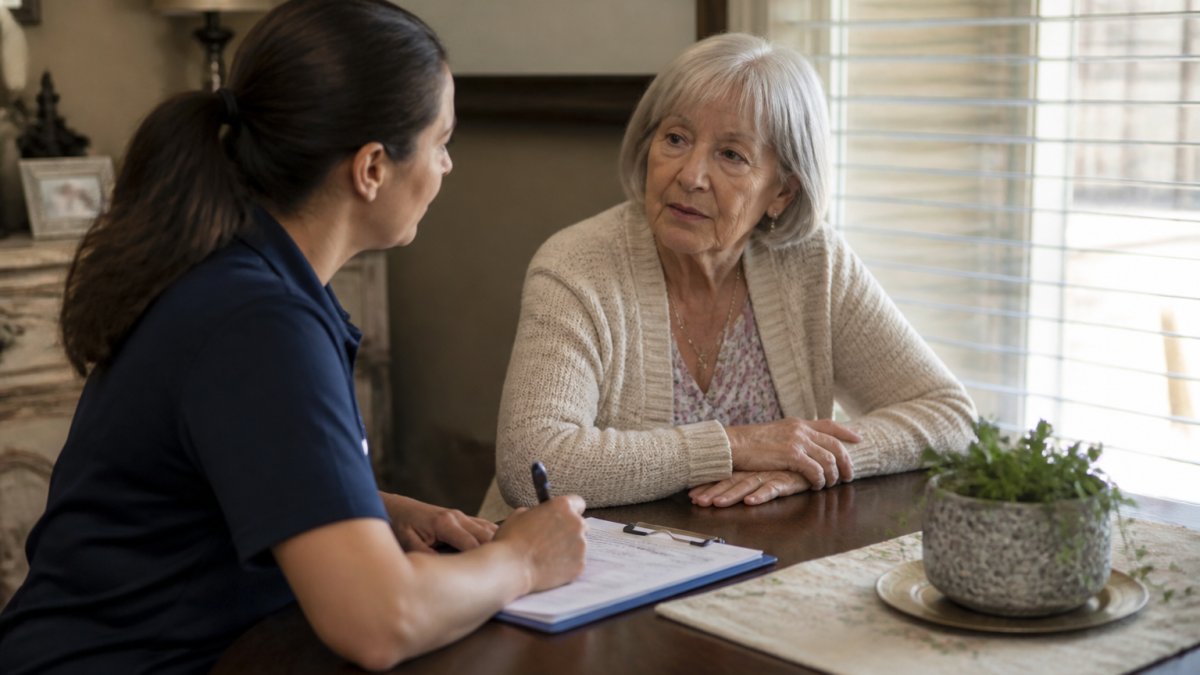
A senior care needs assessment follows a consistent structure: interview, observation, home safety review, and recommendation. The assessor spends time with your parent directly, not just with you.
Expect the assessor to ask your parent to demonstrate daily tasks. They may watch how your parent rises from a chair, walks to the bathroom, or prepares a simple meal. This is not intrusive; it is how the assessor separates what your parent says they can do from what they can safely do.
The home safety walk-through is equally important. Assessors look at bathroom grab bars, stair railings, lighting, floor coverings, and how far the bedroom is from the bathroom at night. These details shape the care plan more than any diagnosis.
Who Should Be Present
The ideal assessment includes your parent, the primary family decision-maker, and the assessor. If your parent has dementia or limited English proficiency, include the person who knows their history best.
Try to have the person who will manage care day to day present. If you live in Morris County and work full time, that may be a sibling or a trusted neighbor. The care plan needs to reflect who is actually available, not who wishes they were.
One caution: too many family members in the room can overwhelm a parent and turn the visit into a debate. Two or three people is usually the right number.
From Assessment to a Personalized Home Care Plan
A personalized home care plan is the written document that translates assessment findings into specific services, hours, and caregiver requirements. It should be detailed enough that a substitute caregiver could step in and know exactly what to do.
A strong plan covers:
| Plan Element | What It Specifies | Why It Matters |
|---|---|---|
| Care hours | Exact days and times of coverage | Prevents gaps in supervision |
| Services | Bathing, meals, medication reminders, monitoring | Defines what the caregiver does and does not do |
| Caregiver skills | Dementia training, transfer training, veteran experience | Matches the caregiver to the actual need |
| Safety measures | Fall prevention steps, home modifications | Reduces injury risk between visits |
| Emergency protocol | Who to call, escalation steps, backup coverage | Protects your parent when you are not there |
Review the plan carefully before signing. If something does not match what the assessor said in person, ask for it in writing. A plan you do not understand is a plan you cannot enforce.
At Live Easy Home Care, every plan is built around the specific findings from the home visit, whether that means hourly support for a parent with chronic conditions or 24/7 live-in care for someone with advanced dementia. Our ACHC accreditation means our care standards are reviewed against an outside benchmark, not just our own.
Conclusion: Taking the First Step Toward In-Home Care
The hardest part of this process is usually the first phone call, not the assessment itself. Many families delay because a parent insists they are fine, or because a previous agency left them without a caregiver at the worst possible moment. A structured assessment gives you facts instead of guesses.
If you are ready to book a professional in-home care assessment in Englewood, NJ or anywhere in Bergen and Morris County, Live Easy Home Care can help. Our team provides ACHC-accredited caregivers, specialized dementia and Alzheimer’s support, 24/7 live-in care, and fall prevention and health monitoring tailored to your parent’s needs. Get started with Live Easy Home Care and give your family the clarity and peace of mind that comes with a real plan.
Frequently Asked Questions
How do I book a professional in-home care assessment in Englewood, NJ?
Contact Live Easy Home Care by phone or through their website to schedule a visit. A care coordinator will ask about your parent’s condition, daily challenges, and your family’s schedule. Most assessments are scheduled within a few business days. The coordinator will confirm the time, explain what to prepare, and let you know who will attend. You can also ask about ACHC accreditation and caregiver training during that first call.
How long does an in-home care assessment take?
Most assessments take 60 to 90 minutes, depending on the complexity of your parent’s needs. The evaluator will review medical history, mobility, cognitive function, medication management, and home safety. If dementia or Alzheimer’s is a factor, the visit may run longer because behavior patterns and wandering risks need careful documentation. Plan for extra time if you have questions about VA benefits or 24/7 live-in care options.
What should I prepare before a home care assessment?
Gather a current medication list, recent medical records, insurance cards, and any VA documentation if your parent is a veteran. Write down specific concerns, such as falls, missed medications, or nighttime confusion. Clear a path through the home so the evaluator can see the actual living conditions. Have a family member or trusted friend join if you expect to discuss sensitive topics. A prepared home care assessment checklist keeps the visit focused.
How soon can in-home care begin after the assessment?
Care can often start after the assessment, depending on caregiver availability and the complexity of the personalized home care plan. Live Easy Home Care will review the plan with you, match a caregiver to your parent’s needs, and schedule a start date. For urgent situations, such as a recent hospital discharge, ask about expedited scheduling when you book the assessment.